Markets U5
Junk Debt Stress Raises New Questions About AI’s Financing Boom
Rising yields and tougher credit markets are testing whether AI’s costly expansion can keep relying on borrowed money.

The strain in the weakest corporate debt is starting to test a central assumption of the AI boom: that companies can keep financing enormous spending plans even as borrowing gets more expensive and lenders become choosier. The warning signs extend beyond AI firms, but the sector’s appetite for data centers, chips and computing capacity makes it unusually exposed to a prolonged tightening in credit.

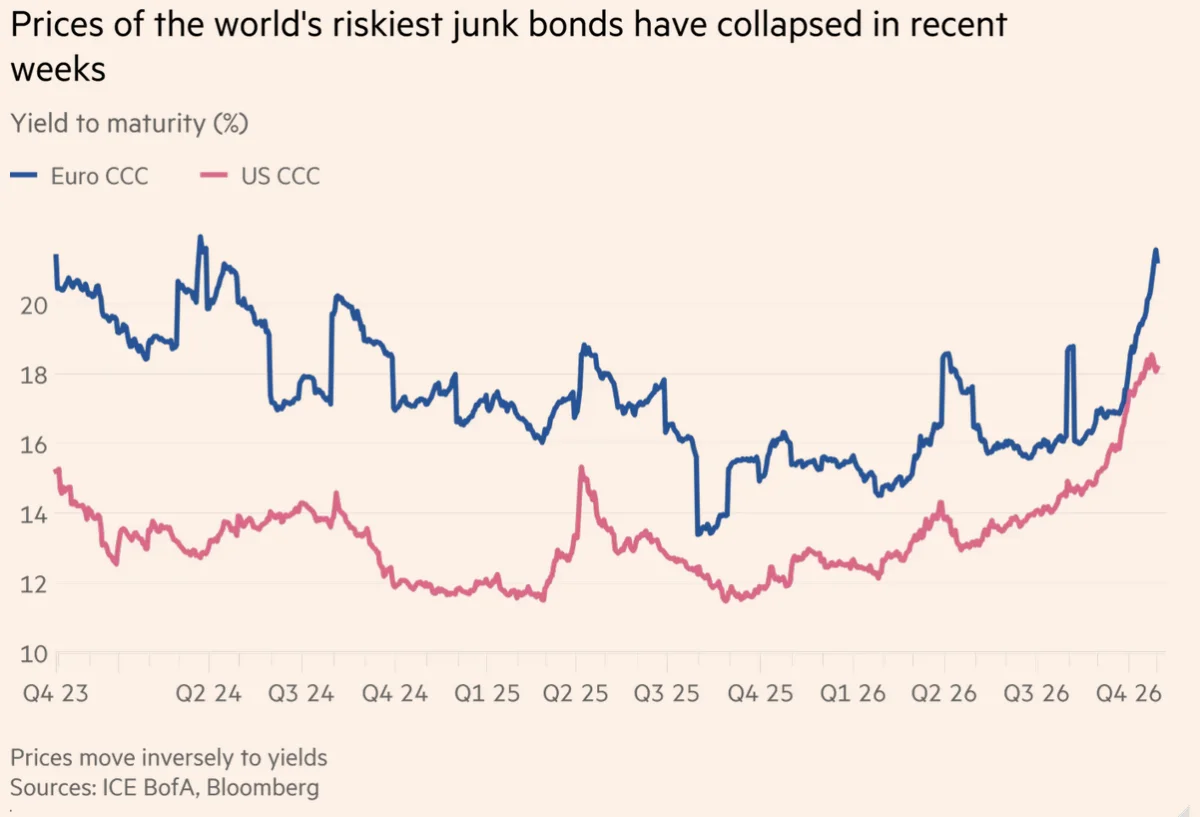
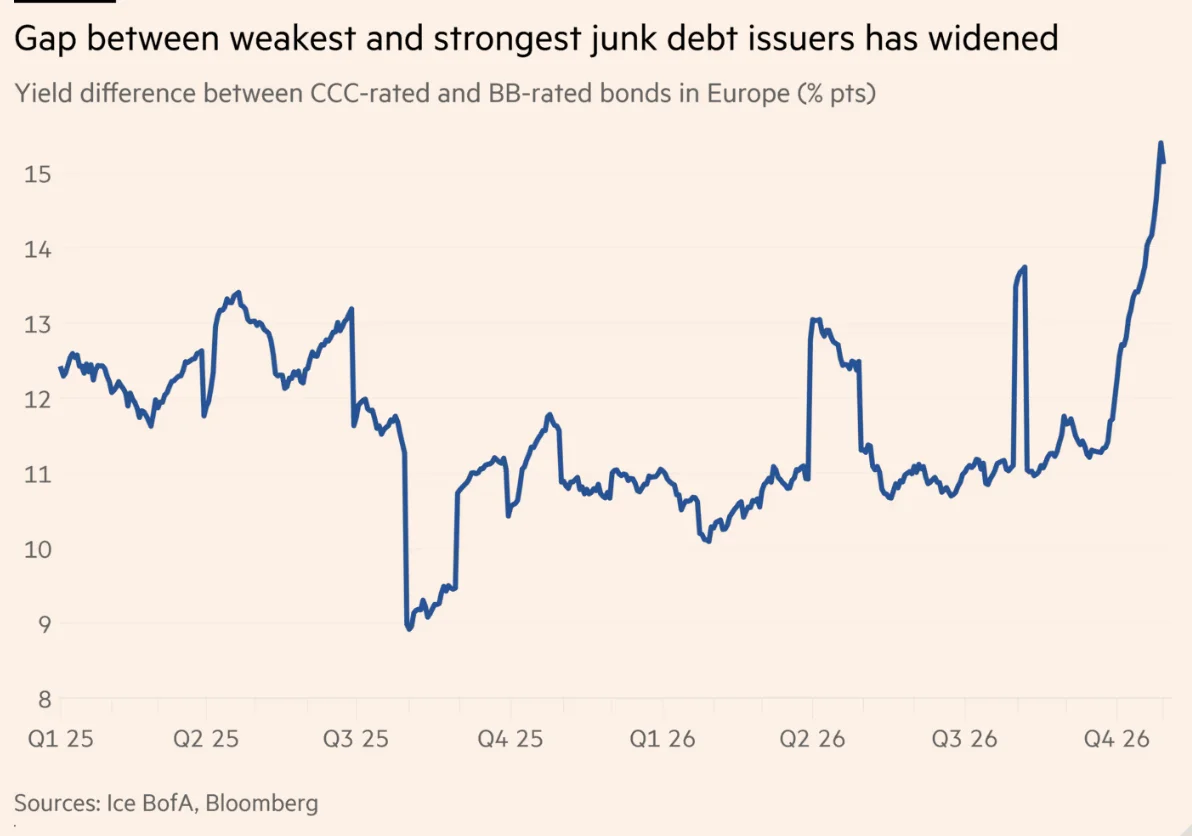
The shift is visible in the lowest-rated debt. Yields on CCC-rated borrowers have climbed to more than 21 per cent in Europe and 18 per cent in the US, up from about 16 per cent and 15 per cent at the beginning of the year. Those figures reflect a sharp drop in bond prices and a widening gap between the weakest borrowers and higher-rated companies. Investors are demanding more compensation for taking credit risk, and some are trying to avoid distressed borrowers altogether.
That repricing matters beyond the companies already under pressure. Credit cycles often turn at the weakest borrowers first: financing grows more costly or harder to secure, then the pressure reaches stronger companies if lenders keep retreating. A stock market decline has historically followed interest rate increases by about five months, though timing varies widely. The current deterioration may still be contained, but it is a measure of how quickly risk appetite can change.
AI’s funding needs meet a less forgiving market
The sums attached to AI infrastructure put the credit shift in context. A Washington Post report described a race by technology companies to raise money for data centers, chips and related equipment, with an estimated $10 trillion in AI spending over the coming years. A draft research paper by Columbia University finance professor Stijn Van Nieuwerburgh estimated that building the infrastructure through 2032 would cost more than $10 trillion.
The financing effort is already drawing in companies with substantial resources. Anthropic, the maker of the Claude chatbot, began preparations for what the report characterized as a potentially record-setting public stock sale, with an estimated $100 billion in proceeds. The company’s paperwork described that sum as an initial contribution toward its plans. Meta said it could sell up to $95 billion in new stock. SpaceX, meanwhile, finalized a complex arrangement to borrow $40 billion for AI chips and equipment less than five months after its prior public stock sale.
Those transactions illustrate the scale of the cash requirement, but they don’t establish that spending will generate returns commensurate with the cost. Large technology companies can draw on cash, equity markets and debt. Smaller firms that rent computing capacity to AI developers have fewer options. These “neocloud” companies often depend on outside capital to pay operating costs, and their financing can become fragile if customers slow their commitments or lenders demand higher rates.
The Washington Post cited a Gartner forecast that 80 percent of neocloud companies could fail or be forced to sell themselves in coming years. That forecast is a warning about business models exposed to high capital costs and concentrated demand. It does not mean every company in the category faces the same outcome. But it underscores how a boom can create dependence well beyond the firms selling AI products: data-center landlords, equipment suppliers and service providers all rely on continued spending.
One account of the sector’s financing describes “take or pay” arrangements, which require a customer to pay for contracted capacity even if it uses less than planned. Such terms can support borrowing while demand is strong. They can also shift risk: if customer needs change, the buyer may still owe payments, while the provider’s equipment and facilities may be difficult to redeploy at comparable value. The source points to these commitments as a reason the financing cycle could reach a difficult phase by 2027 or 2028, though that timing is an assessment, not a certainty.
Credit ratings and market pricing are diverging
Anthropic’s credit rating offers a close-up view of the issue. Kroll Bond Rating Agency assigned the company BB+ in June, the highest rung below investment grade; the rating became public this week, according to the cited account. The assessment relied on revenue, run-rate revenue, adjusted operating income and the company’s own forecast. It did not include free cash flow, leaving analysts to estimate that measure.
The distinction matters. Adjusted operating figures can exclude costs that still consume cash, while free cash flow shows what remains after operating needs and capital spending. Without that figure, lenders and investors have less direct evidence about how much of the planned expansion can be funded from the business itself. The source’s commentator called the rating generous and expected other rating firms could assign lower grades once more complete financial information becomes available. Those views are opinions, not established outcomes.
The debt linked to Anthropic also involves protections from Broadcom. Most of a $35 billion chip-financing package was borrowed at about 5.75%, a low rate for a junk-rated borrower, because Broadcom agreed to cover lenders if the chips had to be sold at a loss. Broadcom is also backing about $42 billion more within a newer $60 billion chip package for Anthropic. Apollo and Blackstone were described as lining up $35 billion to buy chips for the company.
That structure may make financing available on terms the borrower could not obtain on its own. It also concentrates some of the downside risk in the guarantor. If Anthropic falls behind on lease payments and the chips must be sold, Broadcom could be left with a large inventory of used equipment. The source’s commentator argued that this possibility may not be reflected in Broadcom’s share price. That is a risk assessment, not a forecast of a default or a loss.
The arrangement also shows why credit quality can’t be read from a rating alone. A lender may look at the borrower, the collateral, a guarantor and the expected resale value of equipment. Each can change the apparent risk. But used chips may not hold their original value if technology advances, available supply grows or demand shifts. The financing terms therefore depend on assumptions about both the borrower’s ability to pay and the collateral’s value if that ability weakens.
Bond investors are questioning the ratings
Investor and credit commentator Jeffrey Gundlach said market pricing is challenging the ratings assigned to some AI-related borrowers. He pointed to widening spreads on lower-quality credit and a BBB index price of $65, down 18% on a price basis. He also said large debt offerings from AI and adjacent businesses had been met with skepticism, with some bonds trading at spreads associated with much weaker credit than their assigned ratings suggest.
His examples included SpaceX, which came to market at BBB and then traded at a junk-like spread, and Oracle, rated BBB-, whose debt he said was trading more like single-B credit. A bond spread is the additional yield an issuer must offer over a safer reference rate. When that spread widens, investors are charging more to take the same issuer’s credit risk, even if the formal rating has not changed.
Gundlach compared the mood to the market’s loss of confidence in BBB-rated debt in 2006 and 2007. He also said spreads were widening in asset-backed securities, commercial mortgage-backed securities and investment-grade debt. That breadth could indicate a wider repricing of risk rather than isolated concern about one AI borrower. Still, the comparison describes a resemblance in market behavior; it does not establish that the same sequence will follow.
Credit rating firms tend to move cautiously, and downgrades can follow rather than lead market repricing. That creates a gap between the label on a bond and the price investors are willing to pay for it. For borrowers, the gap can matter well before a formal downgrade: a higher spread raises the cost of new debt, and weak demand can make refinancing more difficult. For current bondholders, falling prices can produce losses even when no payment has been missed.
Stress is concentrated, but the market is watching
The Financial Times described a prolonged selloff in the riskiest global debt, with investors cutting exposure to distressed companies in Europe and the US. Its reporting linked the pressure to higher global interest rates, concern about indebted companies facing AI disruption and high energy prices, and worries about France’s fiscal health. Those pressures differ by borrower and region, but they are converging on a market segment with little room to absorb setbacks.
CCC-rated borrowers face especially high yields: more than 21 per cent in Europe and 18 per cent in the US, compared with about 16 per cent and 15 per cent at the start of the year. The spread between CCC-rated and BB-rated bonds has also widened sharply in Europe. Investors who hold large positions can’t always sell quickly without accepting lower prices, so an attempt to reduce risk may itself deepen losses.
“It’s a complete bloodbath,” one portfolio manager at a large US hedge fund told the Financial Times, adding that investors were afraid of being caught in the next blow-up. The remark captures a defensive mood, but it also points to a market mechanism: when managers focus on avoiding the next loss, they may sell a broader set of assets or stop financing new deals, even where a company’s circumstances differ from those of distressed peers.
The pressure on AI-linked credit is arriving alongside doubts about the underlying economic picture. The source argues that the initial third-quarter growth estimate of 3.4% overstates the strength of the economy. It points to a GDP deflator revised down to 2.2% from 6.1% in the second quarter, against a cited consensus expectation of 3.2%, and to inventory accumulation accounting for about 1.6% of the 3.4% total. If final demand doesn’t strengthen, inventories can weigh on future sales. The source also attributes a meaningful part of reported activity to AI capital spending, which it considers unsustainable.

These are arguments about the composition and durability of growth, not proof that the economy is already contracting. They matter to the AI financing story because a buildout funded by debt needs customers with the capacity to spend. If demand outside AI is weak while technology companies borrow heavily to expand supply, the sector may depend on a narrower base of buyers than the headline spending figures imply.
Higher rates test the boom’s central assumption
A Financial Times opinion piece argued that AI firms remain subject to the cost of money, despite claims that potential productivity gains will outweigh higher financing costs. It cited global debt at record levels and said AI-related debt issuance could exceed $600 billion in 2026, up 10-fold from 2024. If rates stay elevated, companies face both higher interest expense and lenders who are less willing to extend credit.
The argument is about timing as much as scale. A credit cycle doesn’t normally turn in a single moment. The source’s comparison with the 2000 and 2008 market downturns emphasizes that weaker sectors can come under pressure first, while investors continue to fund the broader boom. Technology shares began falling sharply in early 2000, the cited opinion piece recalled, yet investors were still putting money into technology funds late that year. The enthusiasm faded over time.
There are differences between today’s AI expansion and the late-1990s technology boom. But the same kind of belief can appear at the end of a cycle: that demand is so powerful, or the potential gains so large, that ordinary financing costs no longer matter. The opinion piece notes that higher rates are already affecting some neocloud firms, while investors continue to argue that tens of billions in additional debt can’t derail the wider AI buildout.
There is a further concern about who benefits from the spending. The cited opinion piece argues that technology investment is not lifting other parts of the economy in the same way that earlier technology booms did. Outside AI, it describes borrowing as weak and investment as falling. If customers across the broader economy are struggling, AI providers may find it harder to turn expensive infrastructure into durable revenue. The size of the buildout alone can’t answer that question.
Hedges show anxiety, not a settled outcome
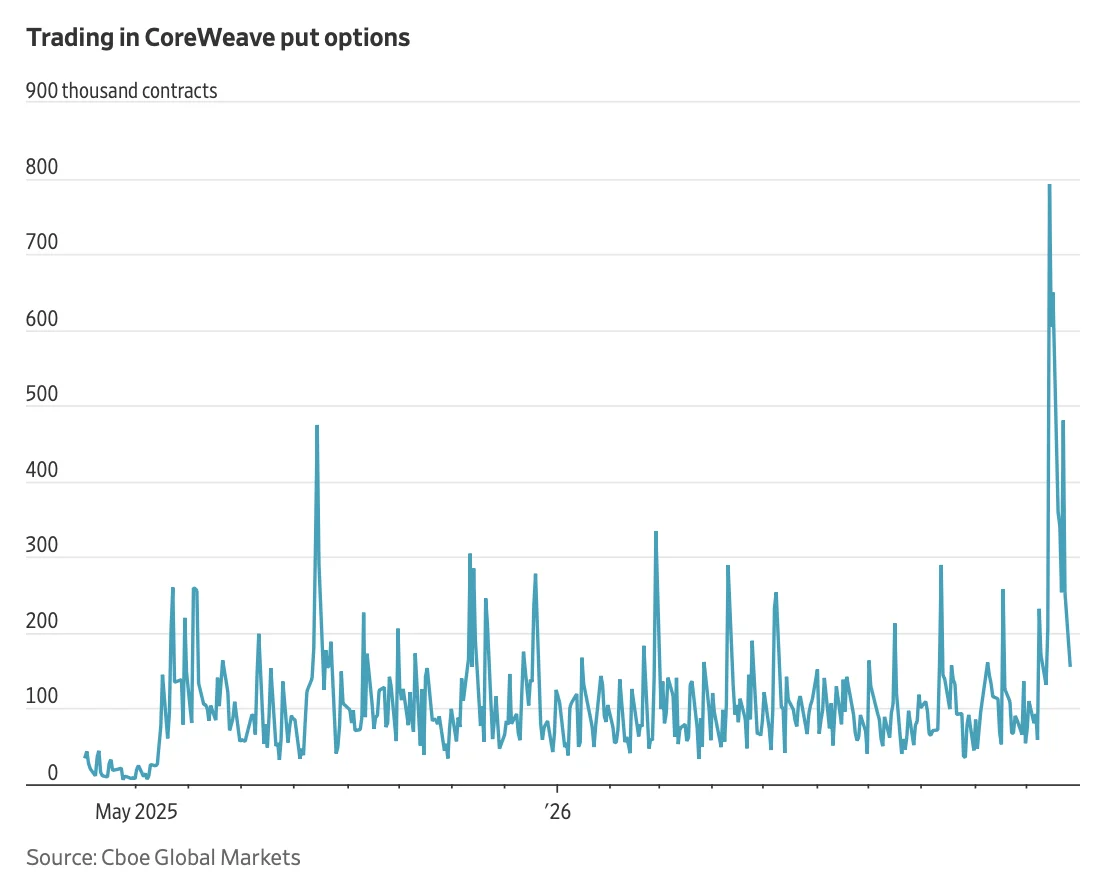
Investors are also paying for protection against losses. The Wall Street Journal reported rising use of put options and credit-default swaps tied to AI companies and major technology borrowers. A put option gives its owner the right to sell shares at a specified price by a future date. The volume of contracts tied to CoreWeave reached a record in October and stayed elevated, according to Cboe Global Markets data cited by the paper.
Some widely traded CoreWeave puts expire in 2028 and pay out if the shares fall to $35. The shares were around $55 that week. The gap between those figures shows the level at which the contracts are structured; it doesn’t show that investors expect the shares to reach that price. Options can serve as insurance, a trading position or both.
The cost of credit-default swap protection on Amazon, Alphabet, Microsoft, Meta and Oracle rose over the prior month to its highest level since 2021, according to data provider Solve. The swaps pay out under specified credit events, and their cost can rise when investors perceive more risk. Eugene Grinberg, a Solve co-founder, said there were no exceptions among the companies he tracked, which he interpreted as broad concern about the sector rather than isolated credit problems. Oracle’s spreads widened by more than 1 percentage point.
These instruments can help investors transfer risk, but they can’t erase it from the financial system. The 2008 crisis showed that protection is only as reliable as the parties required to pay when losses arrive. In that episode, risky housing debt was amplified through leverage and credit-default swaps, then concentrated at fragile financial firms that played central roles in the financial system. The source’s comparison raises a question about where today’s exposures sit and whether a default could disrupt core lending and payment functions.
A large market value doesn’t by itself determine how quickly a downturn unfolds. If exposures are spread widely and don’t impair critical financial channels, the adjustment could be slow, with weak companies kept alive through refinancing and continued support. That pattern can resemble Japan’s long period of subdued growth after its property and stock market bubbles. If borrowing is concentrated in firms or lenders with limited capacity to absorb losses, the same underlying stress could travel much faster.
The available evidence points to a change in financing conditions: the weakest borrowers face sharply higher yields, some AI-linked debt trades at spreads below its formal rating, and companies are turning to increasingly complex combinations of borrowing, equity and guarantees to pay for expansion. Those facts don’t resolve how much AI infrastructure demand will ultimately support, or how losses would spread if planned spending slows. They do make the next stages of credit issuance, refinancing and customer commitments more informative than headline spending ambitions alone.
For shareholders, the risk is that equity values depend on expansion plans whose costs may rise faster than cash generation. For lenders and bondholders, collateral values and guarantees matter alongside ratings. Customers and suppliers may also feel the effects if data-center projects are delayed or providers struggle to finance capacity. The clearest signal to watch is whether borrowers can keep funding the buildout on workable terms while converting capacity into paying demand.
===