Markets U4
Derivatives Firms Assess Perpetuals, 24/7 Trading and Stablecoin Clearing
Most surveyed firms reported stronger first-half performance, while interest in perpetuals and always-on markets remains uneven.

Stronger first-half results are giving many derivatives firms room to assess new products and market infrastructure, but survey responses point to uneven demand for round-the-clock trading. Perpetual futures have reached some institutional execution desks, while most surveyed trading firms remain reluctant to extend certain traditional contracts into weekends.
Two-thirds of firms in Acuiti’s network said their businesses performed better in the first half of 2026 than in the same period of 2025. Just 12% reported worse performance. Against an average year, 64% said results were better, including 31% who described the period as significantly better.
Performance also beat many firms’ own expectations: 52% came in above budget, with 16% significantly ahead, while 19% fell short. Acuiti said sell-side members reported above-average performance compared with the wider listed derivatives market.
Costs and people remain pressure points alongside product development. Third-party technology vendors affected the largest share of respondents, followed by exchange fees. Finding skilled staff was a significant or critical challenge for 35%; 34% said regulatory demands posed a significant or critical challenge, including 11% who called them critical. Rising salaries weighed on another quarter of respondents.
Perpetual futures draw mixed interest
Among institutional execution desks, 16% already offered perpetual futures, contracts without a fixed expiry date. Another 10% were developing an offering, and 37% were considering one. The remaining 37% had no plans to offer the products. Acuiti described perpetual futures as an increasingly visible part of traditional finance.
Adding these contracts can require changes to the risk framework used for conventional futures. Respondents most often pointed to risk management and modelling, particularly how to handle the funding rate. Margin methods and dependable access to liquidity were other concerns. These operational questions help explain why stated interest does not necessarily translate into an immediate launch.

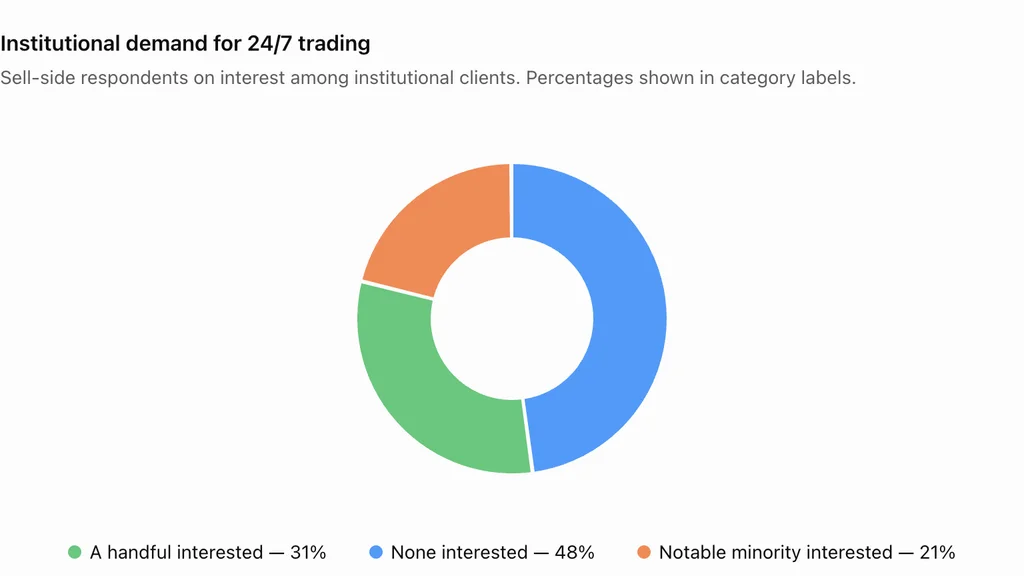
Demand for 24/7 trading among institutional clients appears more limited. Nearly half of surveyed sell-side firms, 48%, said none of their clients were interested. Another 31% saw interest from a handful, and 21% reported interest among a notable minority. No respondent said most of its institutional clients wanted round-the-clock access.
Stephanie Peritore, Head of International Sales at Fidelity Digital Assets, said continuous markets put pressure on infrastructure built around conventional operating hours. In her view, firms need to redesign processes around automation; simply extending existing workflows across more hours does not address the underlying challenge.

The answers on weekend trading underline the gap between interest in new products and appetite for changing established schedules. Among proprietary trading firms, 65% did not support extending hours for certain traditional contracts, such as oil futures, to weekends. Thirty percent said they might support it, while 5% were definitely supportive.
When asked where they would prefer to trade weekend exposures, 73% chose traditional venues such as CME. Native crypto markets drew 20%, and decentralized finance platforms 7%. Acuiti attributed the preference for established venues to existing connections and possible margin efficiencies. The responses suggest that firms considering weekend activity may still favor familiar market access and collateral arrangements.
Stablecoins raise clearing questions
Clearing firms face a related challenge: traditional payment channels, collateral transfers and treasury operations largely follow banking hours. Asked whether stablecoins could help enable 24/7 clearing, 19% of sell-side clearing respondents called them essential and 31% said they would be very important. Another 38% rated them quite important; 13% said they were not important.
Speed alone won’t settle the question. Acuiti highlighted issues including which assets would qualify as collateral, how discounts would be set, and whether custody, redemption and liquidity would hold up in a period of stress or default. For clearing houses, the test is whether collateral can be relied on and turned into cash quickly enough when margin is due.
Peritore said distributed ledger technology would need to sit alongside institutional custody, governance, financing and operational controls to support digital asset use. The implication is that round-the-clock settlement depends on a wider operating system, not just a different way to record transactions.
Clearing ties and near-term outlook
Clearing relationships were largely stable among proprietary trading and buy-side respondents. Three-quarters were satisfied with their current number of futures commission merchant or general clearing member relationships and planned no change. Sixteen percent were looking to add clearing brokers, while 2% wanted to consolidate or reduce their relationships.
Access to new markets or products was the most common reason to review those ties. Cost and fee optimization followed, with margin efficiency and capital optimization also cited. For firms weighing additional clearing relationships, the responses point to product access and the cost of supporting it as practical considerations.
Acuiti also examined artificial intelligence as its use expands across derivatives businesses, alongside tokenisation and 24/7 trading. The organization said it combined its earlier buy-side, proprietary trading, sell-side execution and clearing research into a market-wide report to reflect changes affecting several parts of the industry.
Near-term sentiment was positive for most network members: 68% were optimistic about derivatives business performance over the next three months, including 18% who were very optimistic and 50% quite optimistic. Another 29% were neither optimistic nor pessimistic; 2% were quite pessimistic and 1% very pessimistic.
The survey was anonymous and drew on senior executives from the sell-side, hedge funds, asset managers and proprietary trading firms. Its findings show firms exploring new products and settlement models while still weighing client demand, liquidity, collateral and operating costs. For those building toward continuous markets, the practical test will be whether they can manage funding, collateral and risk reliably at every hour.
Read Acuiti’s Q3 2026 Derivatives Management Insight Report.
===