Stocks U6
Private Equity Owns 35% of Methadone Clinics, but Treatment Access Remains Limited
Private equity firms now own 35% of U.S. methadone clinics. Research finds acquisitions have not increased clinic capacity, while access proposals face debate.
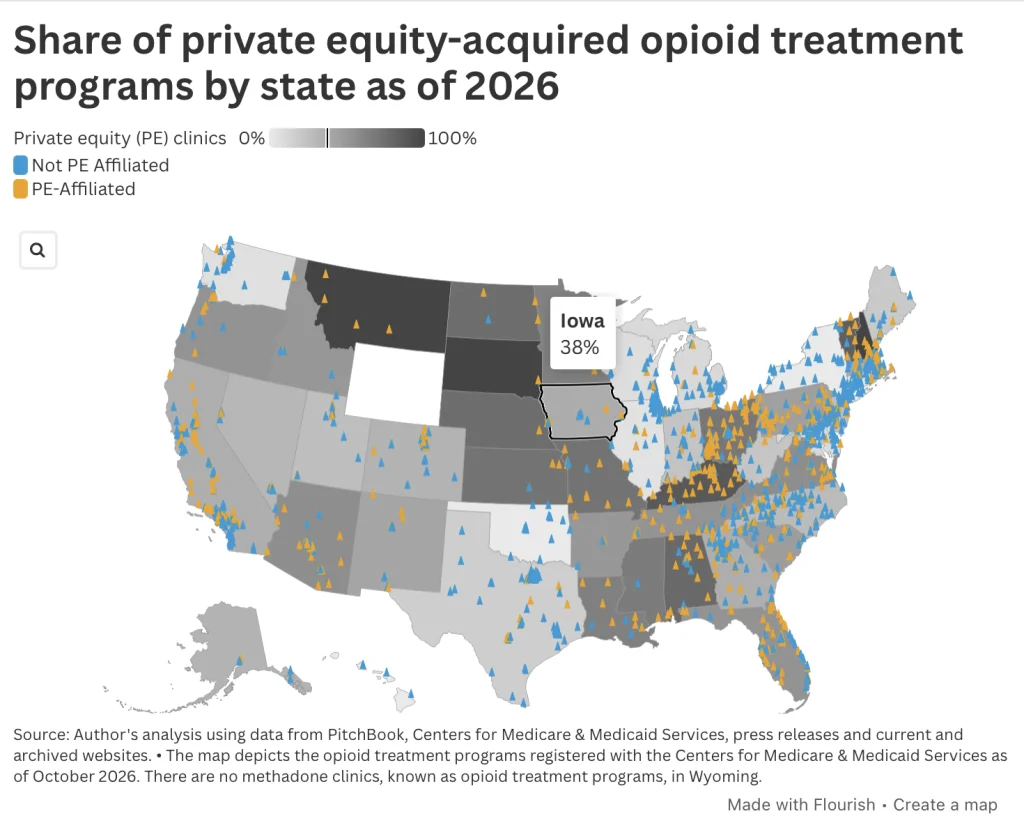
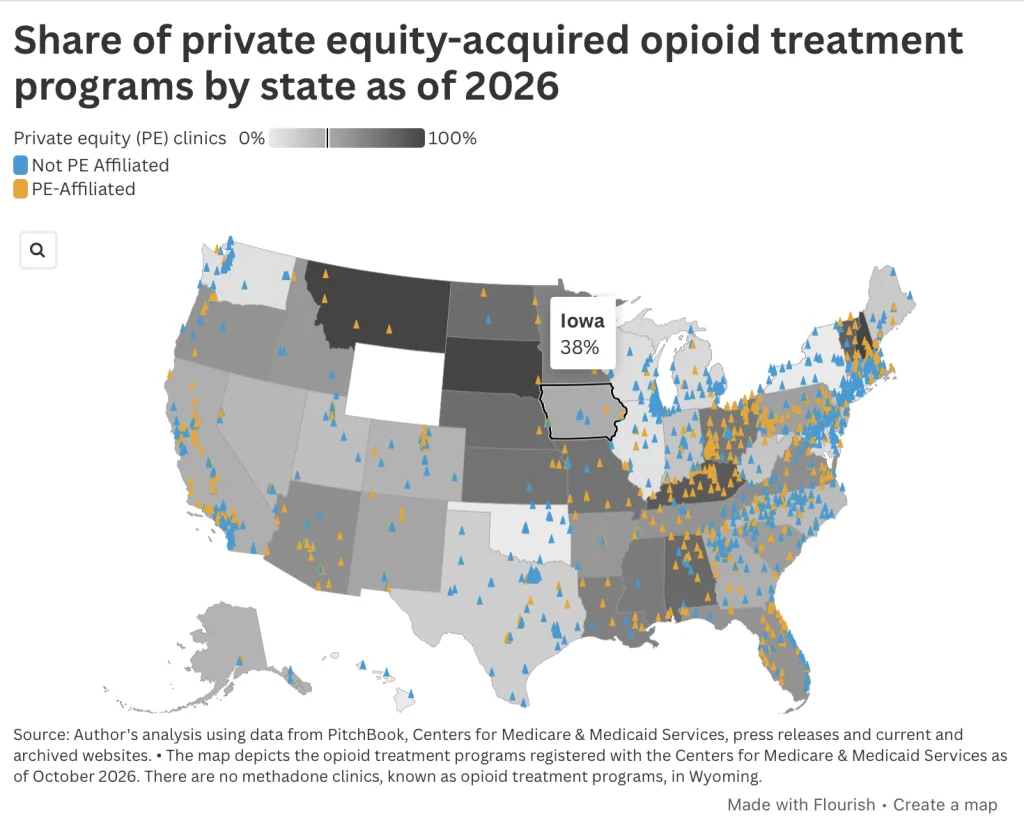
Private equity firms have expanded their reach across U.S. methadone clinics, yet the evidence so far points to a basic gap: ownership has grown faster than treatment capacity. Research by health economist Yashaswini Singh and colleagues found that private equity firms acquired more than one-third of the country’s opioid treatment programs without a measurable increase in clinics or methadone treatment. For patients, a change in who owns a clinic has not necessarily made it easier to get care.
Amber Titus’s experience in rural Arizona shows what access can require. Three mornings a week, she and her husband make the 45-minute drive from Bisbee Junction to Sierra Vista for methadone, a medication used to treat opioid use disorder. They began treatment in early 2025. Titus calls it “a godsend,” but the nearest clinic is about 30 miles away, opens at 4:30 a.m. on weekdays and closes before midday.
Titus needs to receive her dose and reach work by 9 a.m. She says arriving 10 to 15 minutes late can mean missing a dose, even if the clinic remains open. When the couple’s car was totaled in August, she arranged rides through Medicaid. The driver was late each day, and Titus says she missed her dose for the entire week.
That commute is part of a wider system in which methadone is dispensed through specialized opioid treatment programs, rather than ordinary doctors’ offices or pharmacies. In many areas, patients must visit in person every day and take their dose under staff supervision. Rural patients face average one-way drives approaching 50 minutes. Take-home rules differ by state and depend on time in treatment and clinician judgment; among patients receiving take-home methadone, only 19% received a supply of three or more days.
Clinic ownership and local access
The scale of need is substantial. The source reports more than 120 opioid overdose deaths a day in 2025, based on national estimates. Methadone is among the most effective medications for opioid use disorder, and one cited study found it cuts fatal overdose risk by roughly half. Yet research cited in the source estimates that only 22% of people with the disorder ever receive methadone.
As of October 2026, 1,572 methadone clinics were registered with the Centers for Medicare & Medicaid Services. In 19 states and the District of Columbia, firms owned more than half of the providers. These figures describe a growing concentration of ownership within a system where patients often have few alternatives.
Singh’s earlier research examined clinic acquisitions from 2011 to 2019. Within two years of a firm entering a county, it typically controlled 67% of the local methadone market. In more than a quarter of counties studied, one firm controlled the entire market. The later research found that acquisitions generally did not lead to new clinics or more methadone treatment. Methadone shipments and opioid-related deaths were also unchanged during the study period.
The pattern, in Singh’s reading, is more about buying existing capacity than building new supply. Private equity firms have used a “platform and add-on” approach: acquire a larger clinic, then purchase smaller nearby providers. Each deal may look modest on its own, while the combined ownership can give one company control over much of a region’s clinic network.
That structure matters because tightly controlled dispensing limits the ways patients can obtain methadone. Where the number of clinics is small, a firm that owns several can shape where and when treatment is available. The arrangement can also create a financial interest in preserving the existing system if new providers, including pharmacies and doctors, could compete for patients.
Private equity investment is not automatically harmful, and the source identifies a measurable benefit. One study found clinics became significantly more likely to accept Medicare and Medicaid after acquisition, possibly because larger operators can afford the administrative systems needed to bill those programs. Wider insurance acceptance can help patients and clinics. But coverage alone does not show whether more people start treatment or remain in it.
Growth, retention and the limits of the evidence
For methadone, comparable patient-volume data after private equity acquisition was not available. Evidence from buprenorphine, another medication for opioid use disorder that can be prescribed more broadly, offers a cautionary comparison. A cited study found patient volume at acquired facilities rose about 22%, while the share of patients who stayed continuously on buprenorphine for 180 days fell by nearly 8 percentage points. Six months is the national quality benchmark cited in the research. Early treatment discontinuation is a strong predictor of relapse and overdose.
Those buprenorphine findings cannot establish what happens to methadone patients. They do show why counting clinics or insurance plans is an incomplete measure of access. Treatment availability also depends on whether patients can reach a provider, receive care consistently and stay on medication. Titus’s missed week illustrates how a transportation breakdown can interrupt treatment even when a clinic exists and insurance covers the ride.
Company-level experience also complicates a simple account of consolidation. Community Medical Services, commonly called CMS, operated in Montana before its acquisition by private equity. The company owns all four methadone clinics in Montana and three of North Dakota’s four clinics. It also owns the Sierra Vista clinic where Titus receives treatment.
CMS chief executive Nick Stavros said the company had 14 clinics in four states before private equity investment and now operates 79 clinics in 14 states. That total includes five clinics in prisons and three mobile units. Stavros said 49 of the clinics came from new sites, which he described as the majority of the company’s recent growth. He also said no expansion has taken place in Montana. A new clinic costs about $2.5 million, an amount he said many rural areas cannot support.
Stavros previously chose to partner with a different private equity firm after a prospective investor advised closing CMS clinics in Montana and North Dakota as unprofitable. That history points to the difficult economics of serving small or rural markets: private investment may keep some facilities open or finance new locations, while the cost of construction and operation can still leave communities without expansion.
Dispute over changing dispensing rules
A proposal known as the Modernizing Opioid Treatment Access Act 2.0 would allow regular doctors to prescribe methadone and pharmacies to dispense it. Its supporters argue that the current clinic-only model creates avoidable obstacles to treatment. The earlier version of the proposal was introduced in 2023 but did not advance before that congressional term ended. A revised version is under consideration by two House committees; the source said no next step had been scheduled and the term ends in January 2027.
The debate cuts across patient access, overdose risk and the interests of existing clinic operators. Patient advocacy groups and medical societies support the measure. The American Association for the Treatment of Opioid Dependence, a trade group representing methadone clinics, opposes it. Its president, Mark Parrino, said the group objects to giving the Health and Human Services secretary authority to determine which additional practitioners could prescribe methadone for opioid use disorder. The group also objects to allowing dispersible tablets as well as liquid methadone.
Parrino said tablets “were definitely” involved in an increase in methadone-related deaths that began around 1999. The source notes that the Centers for Disease Control and Prevention and a Food and Drug Administration advisory linked those deaths to methadone prescribed for pain, rather than addiction treatment. Research cited in the source has not supported claims that expanded access to take-home methadone increases diversion.
Stavros, who represents Arizona in the trade group, said the proposal would not threaten CMS’ business model. He expressed concern that removing safeguards too quickly could let a small number of poor providers increase overdoses and add to stigma around methadone. He said he would support a slow, gradual transition toward pharmacy dispensing. Dr. Melody Glenn, an addiction and emergency medicine professor at the University of Arizona, supports the proposal but argues it should go further. “It’s time to remove the regulatory barriers to these lifesaving medications,” she said.
The disagreement reflects a central uncertainty: how to widen access while maintaining safe care and continuity. A doctor’s prescription or a pharmacy pickup could reduce travel and scheduling burdens for some patients. The source does not establish how quickly such a model could be introduced or what safeguards would be needed. But the current clinic system’s limits are visible in long trips, narrow hours and missed doses.
Ownership visibility and competition
Two other proposals focus on making healthcare ownership and acquisitions easier to examine. Private equity firms are not subject to the same disclosure rules as publicly traded companies, leaving patients and researchers with limited visibility into who controls some providers. Indiana, California and Maine have enacted or proposed ownership disclosure measures tied to Medicare or Medicaid billing. Vermont passed similar legislation in 2026.
A separate approach would lower the value threshold at which healthcare acquisitions must be reported for review of their effects on competition. Current federal guidelines flag ownership of 30% or more of a local market as a concern. Singh’s research found that private equity chains typically controlled at least 67% of a local methadone market within two years of their first clinic purchase in a county.
Many deals do not trigger the current reporting requirement because a company builds its position through multiple smaller purchases rather than one large transaction. The requirement applies to deals worth more than about $134 million. Some states have proposed healthcare thresholds near $10 million, which would bring more transactions into view before they close. Whether those changes would alter clinic ownership or patient access remains uncertain.
The wider public health context reinforces the stakes. In 2023, approximately 80% of more than 100,000 drug overdose deaths involved an opioid. In 2024, overdose deaths fell to nearly 80,000, with more than 54,000 involving opioids, according to the figures cited in the source. Those annual numbers show improvement in total deaths alongside a continuing toll from opioids.
Methadone already exists as an effective treatment. The evidence presented here suggests that clinic ownership, insurance acceptance and treatment access are separate questions. Investment has helped some operators grow and accept public insurance, while research has not found that acquisitions increased methadone supply. The next test is whether changes in dispensing rules, clinic economics and ownership transparency make treatment easier to reach and sustain.
For Titus, the daily arithmetic remains immediate: distance, clinic hours, transportation and work. She and her husband work for Cochise Harm Reduction, a grassroots nonprofit in rural southeast Arizona. “Addiction isn’t a choice,” she said. “It’s a learning curve and eventually … you get tired of it and you want help.”