Banking U58
Wildfire Risk Models Face a Test Beyond Home Hardening
Spokane’s fires show how homes and everyday objects can carry flames. Active defense could help insurers measure property-level risk.
Wildfire risk at a home doesn’t end at its walls. When flames and wind-driven embers enter a neighborhood, vehicles, fences, decks and other ordinary objects can help carry fire from one property to the next. That changes the protection problem: hardening a building can reduce its chance of igniting, but it may not address the fuels surrounding it or the heat those fuels can produce.
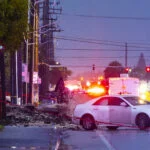
The fires that tore through neighborhoods in Spokane, Wash., illustrate the gap. Powerful winds helped fires damage or destroy nearly 1,000 buildings, while crews faced competing demands to evacuate residents, protect life and suppress the blazes. The author argues that the event exposed a limit in an approach centered on property preparation and hardening: during a fast-moving fire, no crew can be at every threatened home.
When a neighborhood becomes fuel
A fire crossing a supermarket parking lot offered the author a clear example of how flames can move through a built area. Pavement itself supplied little fuel, but cars, plastics and other materials around the buildings could burn. The lesson, drawn from wildfire mitigation work that began in 2001, is that vegetation can carry fire toward a community; once buildings and their contents ignite, the community can help carry the fire onward.

The article points to the 2025 Palisades and Eaton fires, the 2024 Jasper fire and the 2023 Lahaina fire as events in different settings that shared a pattern: extreme fire behavior and wind-driven embers led to multiple ignitions, strained suppression and structure protection, and brought combustible features of the built environment into play. In such conditions, the problem shifts from keeping vegetation from igniting a home to limiting the chance that a burning property will ignite its neighbor.
That fuel load can include homes, sheds, fences, decks, cars, recreational vehicles, delivery packages, outdoor furniture and stored materials. Some exposures can be intense. Tests of fires burning against walls measured heat exposures from 40 to 120 kilowatts per square meter. The article says that is more than five times the level at which wood behind noncombustible siding can begin to smolder.

Frontline modeled a midsize electric vehicle burning 5 feet from a wall at 58 kilowatts per square meter, drawing on peer-reviewed data from six full-scale electric-vehicle fire experiments. The modeled heat flux is nearly 30% above the level at which even two panes of tempered glass failed in testing. That glazing configuration is the strongest one required by the Insurance Institute for Business & Home Safety (IBHS), according to the article.
Fences can add another exposure. At the five-foot setback permitted by IBHS, Frontline modeling estimates that a burning wood fence can expose siding to nearly twice the heat associated with the onset of wood smoldering. A burning deck, boat, hot tub cover, firewood stack or pile of packages could add to the heat or extend how long a property is exposed.

Hardening helps, but has limits
Measures such as ember-resistant vents, defensible space, fuel removal and fire-resistant materials remain part of wildfire preparation. IBHS, an independent nonprofit research organization funded by property insurers and reinsurers, uses testing to study building and material performance. Its Wildfire Prepared Home standard has helped establish a baseline for more resilient construction.
The author’s concern is that a standard built around prescribed exposures and individual building components cannot capture every fuel combination around a modern home. Some common fuels at permitted setbacks may produce more radiant heat than hardened components have endured in testing; for some assemblies, the article says, there is no applicable performance rating. A property faces the actual mix of flame, heat and embers around it, not only a defined test exposure.

That makes property-level risk analysis important. In fire-adapted landscapes, the article argues, exposure should be assumed rather than treated as an unlikely edge case. A useful assessment would consider how direct flame, radiant heat and embers could interact with a particular home—and how that interaction could change if nearby fuels ignite.
Active protection and the insurance question
Standalone exterior sprinklers offer one example of active protection. Firefighters have used temporary systems during wildfires; in Minnesota’s 2007 Ham Lake Fire, 98% of structures protected by sprinklers survived, according to an April 2008 University of Minnesota report prepared for the Firewise Program at the Minnesota Department of Natural Resources. The U.S. Forest Service and National Park Service, as well as services in British Columbia, also routinely deploy temporary systems, the article says.
Intelligent active defense systems extend that approach to properties without a crew on site. They can monitor fire and weather conditions, direct water toward vulnerable surfaces and nearby fuels, and continue operating after occupants leave. Their performance may depend on reliable operation, maintenance, backup power and available water, particularly when power, communications or municipal water are disrupted.
No single measure can guarantee that a building will survive a wildfire. The case presented here is that passive hardening and active defense may work together: one reduces baseline ignition risk, while the other can respond as conditions change. The potential benefit is not limited to a single home; reducing ignitions and property-to-property spread could also help ease pressure on suppression capacity during a large event.
For insurers, the next question is whether those interventions change expected losses enough to affect how a property is assessed. Traditional models rely heavily on regional hazard and historical losses. Physics-based models can compare the same property under the same exposure conditions with and without an active system, offering a way to isolate its potential risk-reduction effect.
That comparison would need credible evidence. The article calls for consistent evaluation based on engineering, testing, real-world performance and clear operating requirements. If the reduction in vulnerability can be measured reliably, insurers could consider it in pricing. Spokane’s experience underscores why that distinction matters: risk can be priced, but reducing it requires protection that accounts for what may burn around a home as well as what the home is made of.