Markets U1
Perpetual Futures and KPI Contracts Put Trading Infrastructure to the Test
Perpetuals and company KPI contracts are testing how exchanges manage funding, liquidity, clearing and risk as trading hours expand.


The spread of perpetual futures and prediction markets is pushing derivatives venues to rethink how they provide liquidity, manage risk and connect trading with clearing. The products differ, but both expose a practical constraint: new contracts need infrastructure that can support their trading patterns and explain their risks to participants.
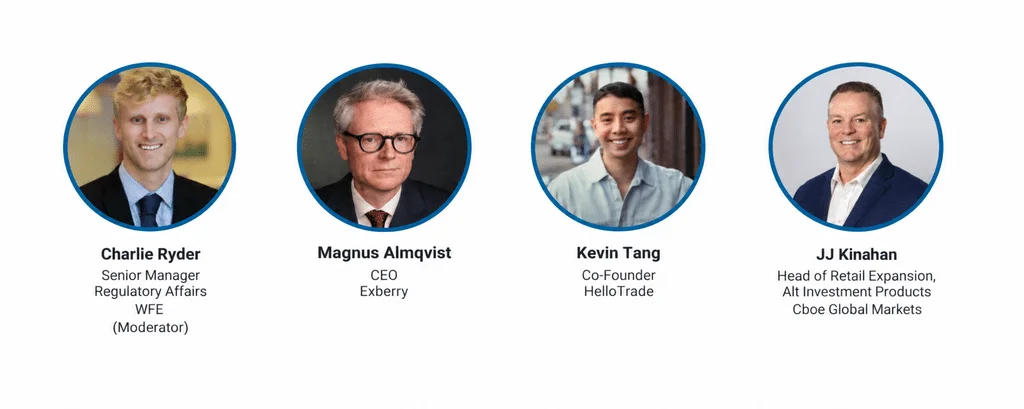
Those questions shaped a recent World Federation of Exchanges webinar, where Cboe Global Markets’ JJ Kinahan, HelloTrade co-founder Kevin Tang and Exberry CEO Magnus Almqvist discussed product design, market access and institutional participation. WFE’s Charlie Ryder moderated the conversation.
Perpetual contracts trade convenience for added complexity
Perpetual futures have gained ground in cryptocurrency markets partly because they don’t expire on a set date. A funding mechanism helps keep each contract’s price aligned with its underlying asset, while allowing positions to remain open. Tang described the contracts as “highly capital efficient” and said their relative simplicity compared with traditional futures and options has aided adoption.
That simplicity has a limit. Funding payments can change the economics of a position over time, even when a trader’s view of the underlying price proves correct. Kinahan said a participant might anticipate a price increase and still owe funding while holding the position. For retail customers, understanding that recurring cost is central to judging how a perpetual contract behaves over longer periods.
The point has implications for product design as well as customer education. A contract that is easy to enter can still be difficult to assess if its carrying costs vary with market conditions. Platforms need to make those costs understandable alongside price exposure, and participants need to account for the funding mechanism when deciding how a position performs over time.
KPI contracts focus on company outcomes
Kinahan described Cboe’s plans for prediction contracts linked to corporate key performance indicators, or KPIs. These would let participants take a view on a specific financial outcome at a company rather than simply on whether its shares rise or fall.
The distinction matters because a company can report strong results and still see its stock react negatively. Guidance, expectations and other factors can shape the share price response, leaving company performance and stock direction at odds. Kinahan said KPI contracts could let participants focus on the parts of a business they are tracking: “What KPIs allow you to do is to really dig down and have an investment opinion on the areas of a company you’re actually observing.”
He said Cboe is focusing on financially relevant events, excluding sports and entertainment contracts. Kinahan compared the potential path for KPI products with the growth of zero-days-to-expiration options, where retail interest drew in market makers and later institutional participants. That comparison points to a possible sequence of adoption, though each product still needs enough liquidity and a workable trading and clearing setup.
Clearing has already shaped Cboe’s plans. Kinahan said the Options Clearing Corporation, which traditionally clears the exchange’s options, could not immediately support the proposed contracts while modernizing its technology. Cboe therefore sought to use its own clearing infrastructure. At the time of the webinar, Kinahan said the product had received permission and the exchange was waiting on approval for the clearing arrangement.
Liquidity and operations shape market access
For blockchain-based platforms, building a market around perpetuals requires more than making a contract available. Tang said new venues need capital and market makers, as well as both maker and taker liquidity. Attracting enough participation to support trading can be difficult for a new platform, particularly before customers have confidence that they can enter and exit positions reliably.
Tang sees trading incentives, permissionless participation and new liquidity arrangements as ways blockchain platforms may support capital formation. He also pointed to investors in emerging and frontier markets who can have limited access to traditional brokerage services. That potential reach depends on the venue’s ability to sustain liquidity and manage the risks that come with continuous trading.
Almqvist said extended hours and new instruments put pressure on the systems linking an exchange’s matching engine with collateral, settlement and risk functions. In a continuous market, those processes have to keep pace as trading activity changes outside familiar operating windows. “You need a settlement and risk function that sits very, very closely with your matching engine,” he said.
Traditional market structures have often kept matching, collateral management and clearing in separate systems. Almqvist argued that newer products require tighter coordination, enough capacity for volume surges and the ability to introduce upgrades without interrupting operations. Event-driven contracts can concentrate trading around particular outcomes, making sudden spikes an operating requirement to plan for rather than an edge case.
Risk controls and institutional participation
Risk controls become more complicated when contracts reference traditional assets whose prices may not be available around the clock. Tang said platforms need safeguards such as price bands, open interest limits and circuit breakers, drawing on tools used in established markets. The challenge is to apply them to products that trade continuously, including during hours when the underlying market may be closed.
Kinahan warned that failures in risk management can damage confidence beyond the venue where they occur. “If somebody has bad risk management, it actually reflects on the whole industry,” he said. For exchanges and platforms seeking broader participation, dependable controls are part of the market’s credibility.
Tang said hedge funds and institutional market makers already participate in cryptocurrency derivatives. Still, firms considering on-chain trading face technology integration, compliance demands and exposure to smart contract failures. He called smart contract risk the biggest blocker he sees for institutional use of on-chain venues. Traditional portfolio managers are also watching weekend perpetual prices for clues about where underlying markets may open when regular trading resumes, though those prices don’t remove uncertainty about the subsequent move.
Kinahan expects more interaction between traditional derivatives firms and blockchain platforms, including as venues consider longer trading hours and changes to clearing. Tang likewise expects the two types of market to converge as institutional participation grows, but said perpetuals and prediction markets are unlikely to displace established options and futures. The pace of adoption will depend on whether providers can pair access to new contracts with clear costs, reliable liquidity and risk systems built for the hours and conditions in which those contracts trade.