Markets U62
Meb Faber’s 2026 Portfolio: Private Startups, Real Assets and Trend Strategies
Faber says his wealth centers on founder stakes and startups, while his public portfolio blends global assets with trend strategies.
Meb Faber describes a portfolio built around two very different sources of risk: businesses he founded and hundreds of private startup investments, alongside a public portfolio designed to spread exposure across asset classes and respond to market trends. His allocation reflects a founder’s mix of wealth creation and wealth preservation, shaped by a young family, a preference for sleeping well and an explicit willingness to let funds make decisions automatically.
The details are a personal account, not a model intended for other investors. Faber says his figures are approximate and that the broad structure matters more than precise percentages. His central point is how the pieces fit together: concentrated ownership in his own companies, a large private investment book, real assets and a rules based public allocation.
Founder wealth sits at the center
Faber estimates that Cambria, his asset management company, and The Idea Farm, his research company, account for somewhere between 75% and 99% of his net worth. The exact share is uncertain, but he says ownership in those businesses is the largest determinant of his wealth. For business owners, that concentration can make their fortunes depend heavily on the companies they built.
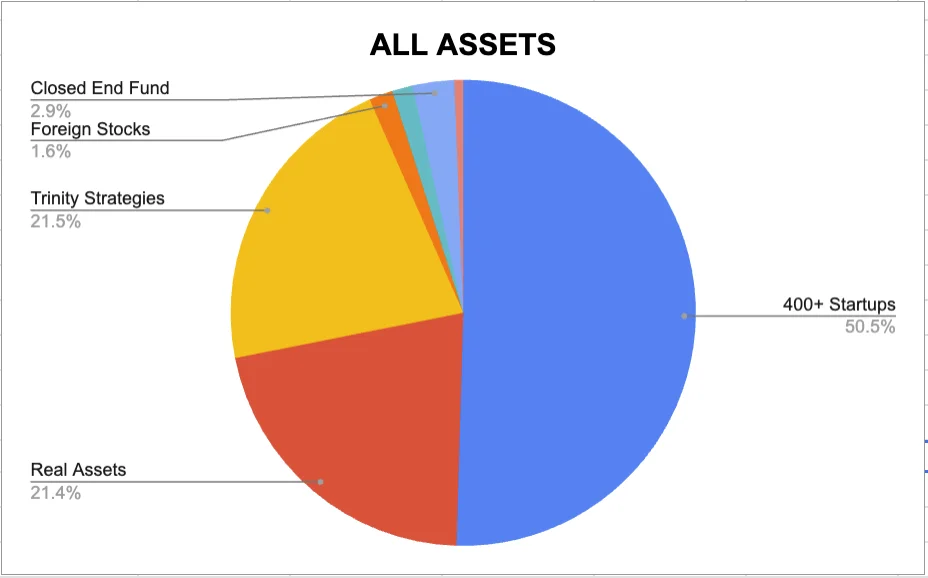
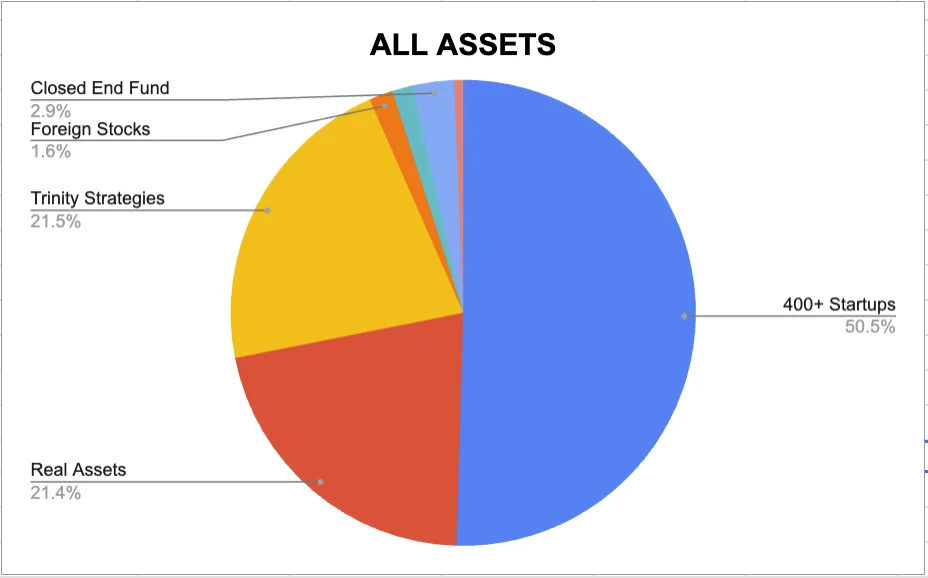
He groups those founder stakes with wealth creation. Outside Cambria and The Idea Farm, his holdings are weighted toward private startups: about 50% in investments across more than 400 companies. Real assets such as housing and farmland account for 20%, with the rest in his portfolio of publicly traded investments. Faber says he would prefer these three broad categories to be closer to equal, though appreciation and other changes have pushed them out of balance.
That target recalls the ancient Talmud portfolio, which divides assets among land, businesses and reserves. Faber points readers to the Global Asset Allocation PDF for further discussion of allocation approaches, including that framework; a second edition is planned for 2027.
The categories serve different purposes. Farmland is a relatively steady, income producing holding with returns that may move independently of other parts of a portfolio. For Faber, it also carries personal value because of his family’s Midwestern roots. Land offers a tangible connection to place, and its value does not update every minute alongside traded assets.
His direct farmland holdings have since been sold. He has shifted into farms through private platforms, seeking exposure across crops and locations while leaving day to day operations to others. The decision became less about sentiment and more about the economics of ownership: farming takes work, and younger members of his family were not interested in carrying it on. Faber plans to add to farmland over the next few years and can still visit his brother when he wants time in the region.

He also leans toward counting his home as part of the portfolio, though he says the classification is debatable. That question points to a broader issue in personal allocation: a home can be both a place to live and a large asset, but its practical role differs from an investment held chiefly for financial returns.
Startup investing: long timelines and uneven outcomes
Faber’s angel investments sit in his wealth creation category, with the possibility of losses large enough to make them a “Get Poor” holding instead. He has written about the experience in “Journey to 100x” and discussed it on the podcast. He cites long, potentially indefinite holding periods and tax benefits as features of the approach, while acknowledging that results remain uncertain.
So far, Faber has participated in more than 400 deals. Around 100 have reached an exit: 53 went bankrupt or became total losses, 27 were acquired, seven completed IPOs and 11 produced secondary liquidity. Most of the investments remain open, and many are still early in their development.
Some open positions have attracted follow on financing, and a few are valued on paper at more than $1 billion. Faber cautions that this is an incomplete picture and that the period has been unusually favorable for private angel investing. The test, in his view, is whether the portfolio holds up across a full cycle over the coming decade. He recalls living through the severe startup downturn of the early 2000s and expects the current group to include both winners and losers.
Among the investments he has cashed out, the largest gains were 23 times and 57 times the original amounts. He is still waiting for a 100 times outcome. Those results illustrate the skewed distribution of returns that can characterize both private and listed companies: a small number of exceptional performers can matter greatly, while many investments fail to deliver.
Private holdings also change the investor’s behavior. A startup stake may be difficult or impossible to sell at will, which can spare an investor from selling too early after a large gain. Faber asks whether he would have held a listed stock through a doubling or tripling and answers that the odds of selling would have been high. Long term ownership may sound straightforward, but remaining invested can be difficult when an asset is liquid and its price moves every day.
Because his investments began in different years, the portfolio spans companies from startups valued around $2 million to established businesses with cash flow and valuations above $10 billion. Faber plans to continue investing in startups as opportunities arise. The range of company stages and outcomes makes patience central to the approach, but it also leaves the ultimate performance uncertain.
A public portfolio built to run automatically
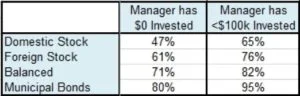
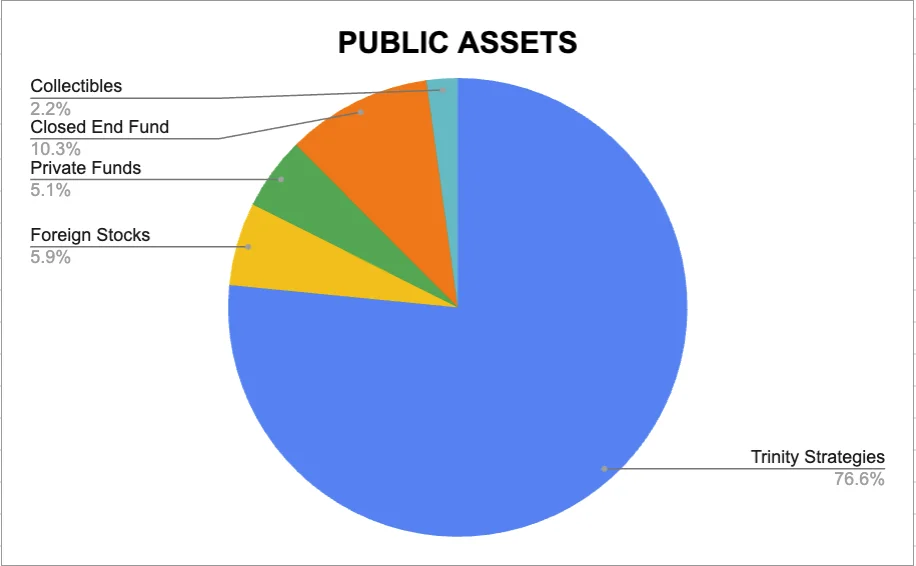
Faber says he puts nearly all the public assets available to him into funds he manages, then leaves the allocation on autopilot. He argues that a fund manager’s own investment in a fund can show whether the manager has personal exposure alongside clients. Citing information from Russ Kinnel at Morningstar FundInvestor, he points to a chart showing the share of managers with none of their own money in the funds they run.
In Faber’s view, that gap raises questions about alignment. He criticizes parts of the mutual fund business for high fees, tax inefficiency, sales loads and 12b-1 fees, while arguing that a manager should be willing to invest in a fund they ask others to own. He recognizes that a manager may have reasons to avoid concentrating all personal assets in a single product, but says there should still be a clear answer to whether they would invest in it.
His own approach is expressed through Cambria’s publicly traded Trinity ETF, TRTY, and Trinity strategies available through Betterment. He describes the aim as moderate risk, with returns above a simple buy and hold portfolio and lower volatility and drawdowns. Those goals are aspirations, not guarantees, and he says the right allocation is the one an investor can live with through difficult periods.
Trinity combines two halves. One is a strategic global allocation across stocks, bonds and real assets, with tilts toward value and momentum rather than standard market capitalization weighting. The other half uses trend following strategies. The strategic portion provides broad exposure; the trend portion aims to reduce volatility and drawdowns while targeting returns similar to buy and hold, with a lower correlation to it.
The underlying concern is that a conventional portfolio can move in the same direction as an investor’s employment prospects and the broader economic cycle. If business conditions weaken, both financial assets and human capital may be under pressure at once. Trend strategies are intended to behave differently in some market declines, though they can be frustrating when markets rise and the trend signals lag.
Faber says the mix suits his own instincts as both a trend follower and a value investor. He wants part of the portfolio able to shift toward cash or hedges when markets trend down, and he notes that many of the trend strategies currently hold substantial real assets, including commodities and real estate. Those exposures could help if inflation remains elevated, though that outcome is uncertain.
The value component gives him exposure to assets he considers inexpensive over long periods, including foreign stock markets. Combining the two approaches lets the strategies make adjustments without requiring him to decide when to buy a cheap market or exit one that has risen. He wants the process to be objective, automatic and tax efficient, reducing the chance that emotion will drive trades.
That preference for automation also applies to what he considers his cash allocation. Faber says his thinking has changed: he now invests most money that might otherwise sit in cash through a broad allocation fund, retaining only a small amount for near term living expenses. He argues that cash can carry meaningful risk after inflation, while offering less potential return than a diversified allocation. The choice reflects his own tolerance and time horizon; it does not remove the possibility of loss.
He currently holds only a tiny allocation to tail risk strategies, which he views as a hedge against the risks attached to his career and private company holdings. He says he would add substantially more if the stock market entered another downtrend. That makes the allocation conditional: its size could change as market conditions and the risks around his other assets shift.
Some tax exempt accounts have limited fund choices. For those, Faber uses what he considers the best low cost long term options available to him: foreign and emerging market stocks. The choice gives those accounts international exposure despite their narrower menus.
His smallest holdings include rare coins, comic books, art and other collectibles. Rare coins belong in both his wealth preservation and personal enjoyment categories. He says he has held some comics for more than 30 years and has also invested in several paintings through Masterworks. These assets make up a tiny slice, and their place in the portfolio reflects interests as well as financial considerations.
Crypto occupies what Faber calls a “regret minimization” category. He says he is not drawn to cryptocurrencies as an asset class, but would consider an allocation around 0.5%, in line with their share of the global market portfolio, to avoid regretting a large rise. He wishes there were more low cost public options available for holding the exposure. He finds crypto companies more interesting than cryptocurrencies themselves and has made about a dozen investments in that area.
What the allocation is meant to support
Faber’s account is shaped by competing priorities. Founder equity and startups expose him to the possibility of substantial growth, while diversified funds, real assets and trend strategies are intended to help preserve wealth. A young family gives him reasons to keep building financial resources; concern for the family’s future gives him reasons to manage risk. He says this balance is what works for him now and expects it to change over time.
The larger message is about the purpose of money. Faber asks readers to connect financial decisions to the lives they want to lead: travel, helping grandchildren with education, supporting a local cause, backing new entrepreneurs or simply spending time fishing with friends. His mother and grandmother put it more simply: “You can’t take it with you.”
He closes with George Mallory’s reflection on climbing Everest: the climb brings no material prize, but offers “sheer joy,” which Mallory calls “the end of life.” The passage returns the portfolio discussion to its underlying question. Investments can help fund a life, but the allocation itself is only a means; its value depends on what it lets a person do.
Meb Faber is the Founder and Chief Investment Officer of Cambria Investment Management, L.P. (“Cambria”), a registered investment adviser. The information set forth herein is for informational purposes only and does not constitute financial, investment, tax or legal advice. Please see the appropriate professional advisor for advice specific to your situation. There is no guarantee that a particular investment strategy will be successful. Opinions expressed herein are subject to change at any time. Past performance does not guarantee future results. All investments are subject to risks, including the risk of loss of principal.